Technology
The Engineering Behind One Press
A long-range radio, a zero-standby display, and an event-driven power budget — put together so an alert leaves the wall and reaches the right team without depending on building IT.
The Stack
Every Component Chosen for Uptime, not Features
Emergency hardware fails in the gaps: dead batteries, weak signal, unreadable screens. Each layer of the stack removes one of those gaps.
LoRaWAN Class a Radio
Sub-GHz long-range transmission penetrates concrete and steel where Wi-Fi and cellular degrade. Class A keeps the radio asleep between events for minimal power draw.
Low-Power E-Ink Display
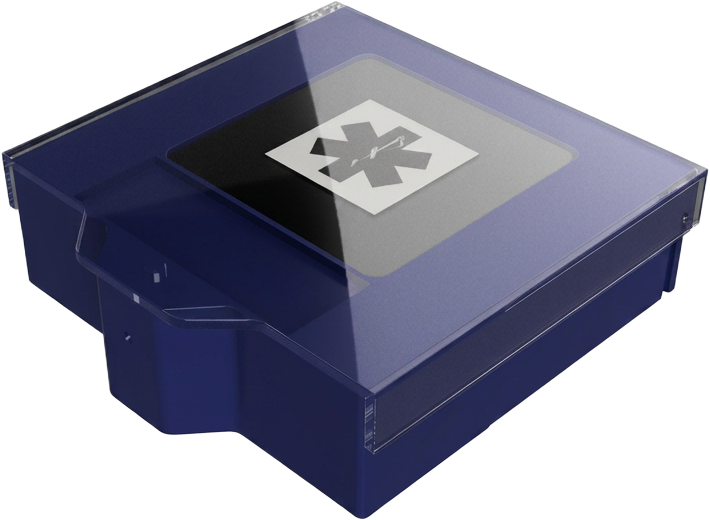
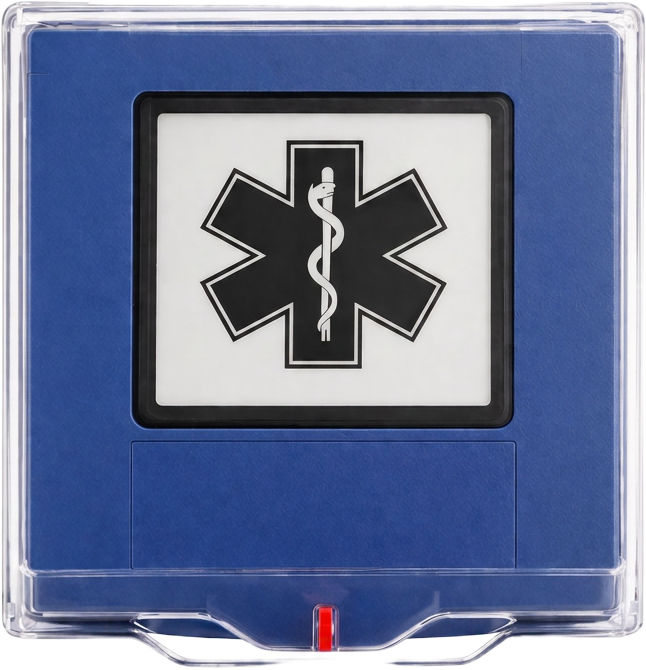
Bistable display holds its last frame with zero standby power. Custom text and icons stay readable in direct sunlight and in blackout conditions.
Multi-Year Power Budget
Duty-cycled firmware, event-driven wakeups, and a bistable screen keep the energy budget low enough for years of field operation between service visits.
Optional BLE Mesh
Bluetooth Low Energy provides local commissioning and over-the-air firmware updates without pulling devices off the wall.
NFC Validation
Optional tag-based authorization gates activation for restricted scenarios such as evacuation triggers.
Onboard Sensing
Temperature and humidity telemetry rides the same uplink, feeding facility management systems without extra hardware.
Signal Path
From Press to Acknowledgment
Four hops, each independently observable.
- 1
Device
Press detection, debounce, and payload assembly happen on-device. The E-Ink screen updates locally so confirmation never depends on the network round trip.
- 2
Gateway
LoRaWAN gateways cover a site with a handful of units. Uplinks are received by every gateway in range, so a single gateway failure does not drop the alert.
- 3
Network + Routing
The network server deduplicates uplinks, decodes the payload, and hands the event to the routing engine, which applies your escalation rules per scenario and zone.
- 4
Delivery + Downlink
Notifications fan out to control room, pagers, and third-party systems over webhooks and APIs. A downlink writes the acknowledgment state back to the device screen.
Technical Snapshot
Specifications at a Glance
No unsupported claims. Final specifications are confirmed for your rollout.
Radio
- Protocol
- LoRaWAN Class A
- Band
- Regional ISM (sub-GHz)
- Topology
- Star-of-stars via gateways
- Optional
- BLE mesh, NFC
Display
- Type
- Bistable E-Ink
- Standby power
- None to retain image
- Content
- Custom text and icon sets
- Readability
- All lighting conditions
Power
- Source
- Battery-powered
- Design life
- Multi-year field operation
- Monitoring
- Battery level reported in telemetry
- Servicing
- Field-replaceable cells
Integration
- Interfaces
- Webhooks and REST API
- Sensors
- Temperature + humidity
- Management
- Cloud configuration console
- Deployment
- On-site gateways, cloud routing
Reliability Engineering
Designed Around the Failure Modes
Redundancy where it matters, dormancy everywhere else.
- Local on-device confirmation independent of network latency
- Overlapping gateway coverage removes single points of failure
- Event-driven duty cycling keeps devices dormant until pressed
- Battery and link-quality telemetry surfaced before failure
- Firmware updates delivered over the air
- Tamper-resistant housing with protected activation cover
Integration
Open Interfaces, No Closed Loop
Webhooks
Every alert event posts a structured payload to your endpoint: scenario type, device ID, zone, timestamp, and battery state.
REST API
Query device fleet health, push downlink screen content, and manage routing rules programmatically from your own tooling.
Facility Systems
Environmental telemetry and alert events feed BMS, security platforms, and control room software alongside your existing sensors.
Want the Full Technical Dossier?
Tell us your facility type, construction, and site count. We will share coverage modeling and integration detail for your rollout.